
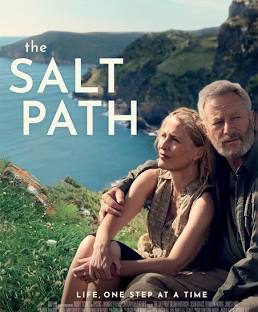
Some of you may remember that I wrote a blog back in February about historical fiction vs non-fiction works (Are Readers feeling cheated?) and how it is important to differentiate between the two and for authors to be honest with the reader. The Salt Path is an incredibly successful non-fiction work by Raynor Winn, published by Penguin in the UK, that a journalist at The Spectator has attacked. It appears that nothing is true in this non-fiction work. It is the story of Winn’s (real name Sally Walker) walk along the southwest coastal path in England with her husband Moth, after creditors seized their house, and how Moth was suffering from CBD, a rare neurogenerative disease that leads to an early death.
The book came out in 2018, and already it has been adapted into a hugely successful UK feature film starring Gillian Anderson and Jason Isaacs. Penguin has defended the book by saying it did all its due diligence in checking out Winn’s story, but it appears that the novel is pure fiction. Nothing about Winn's story is true. Already, Penguin and Winn are planning further ‘memoirs’ with the same cast of characters. The journalist exposed the fact that Winn defrauded people and lost her house due to her dishonest lifestyle. Her husband also appears to be in good health and seems to show no signs of the debilitating disease. Furthermore, all this time, the couple owned land and a house in France where they could have gone to stay.
True stories that later turn out to be pure fiction are quite common. A similar case concerned the author James Frey, who came out with a sensational memoir about addiction and rehab entitled A Million Little Pieces back in 2006. It was a huge bestseller for Random House and was recommended by Oprah’s Book Club. After the scandal came out that Frey had fabricated large parts of his memoir, Oprah Winfrey attacked him on her show, leading to one of the most controversial interviews in the show’s history. Frey’s fabrications sparked a national debate over the definition of a memoir.
Raynor Winn could have avoided all this controversy with a short author note telling her readers that her book was a work of fiction and was not based on a true story, but of course, the novel would not have sold as well. True stories have a huge impact on the reading public. Fictional novels are in a different category, but can still be very successful if presented honestly.
Comments ()