
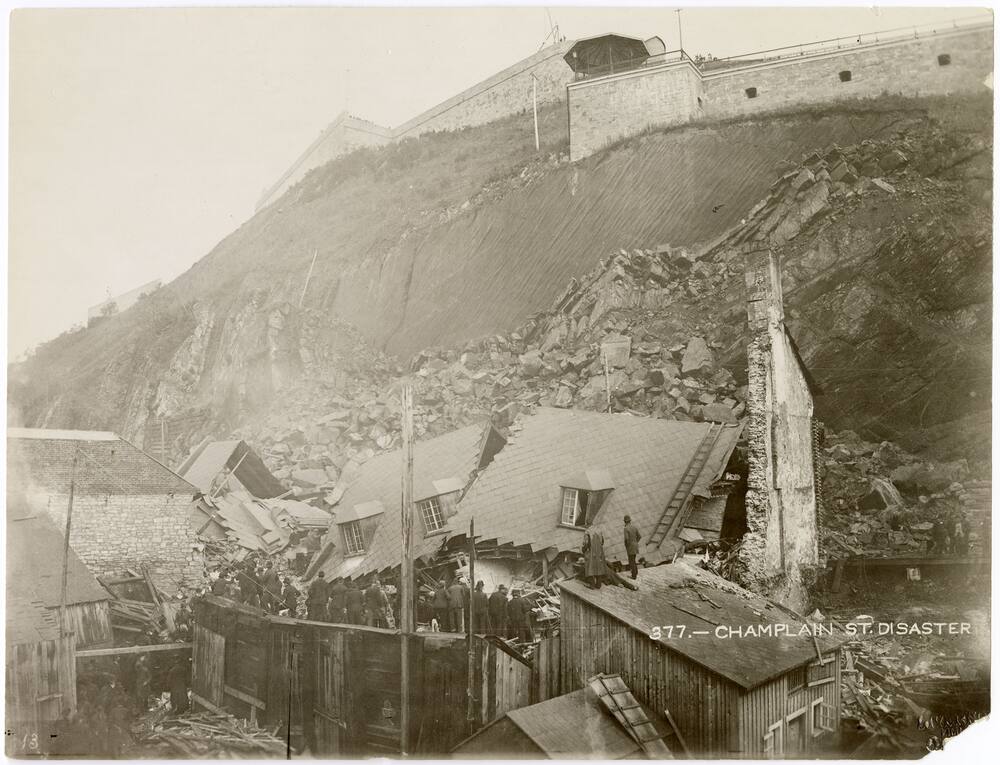
I recently saw an interesting article the other day in the Journal de Québec about the famous rock slide that occurred in Quebec City on September 19, 1889, after a day of heavy rain. An overhanging piece of slate rock broke off from Cap Diamant just below the Chateau Frontenac and fell 300 feet onto the houses below. The homes of 28 families on Champlain Street were crushed, burying a hundred people under eighty feet of slate. The final death toll exceeded forty people.
The journalist couldn’t understand how all the victims were English-speaking Irish immigrants who lived along Champlain Street and toiled in the ship-building industries along the river. There was not a single francophone name on the list. People in Quebec City seem to have forgotten that some forty percent of the population were Irish, English and European immigrants. Quebec City was a port city with transatlantic steamers coming and going every day of the week. It remained a military stronghold after the thousand or so British soldiers paraded in the streets singing “Goodbye, Sweetheart, Goodbye” on their way to ships that would take them home in 1871. There were dozens of factories making shoes, corsets and furniture after the wooden shipbuilding industry collapsed in the late 1870s. It was not the bourgeois francophone backwater as it is perceived to be today. So let’s get back to our rock slide story.
There had been rock landslides before along the same cliff face. In May 1841, boulders from Cap Diamant had demolished eight houses and killed thirty-two people but had not stopped residents from building so close to the cliff face. In September 1889, the rock slide along Champlain Street was worse. Thomas Farrel, a ship labourer from Ireland lived at 155 Champlain Street with his wife Catherine (nee Kennedy) and their children. He was standing with Thomas Nolan and George Haydon in front of Timothy Berrigan’s door when the rocks started falling. As more rocks began to fall, Haydon ran back to his home to save his family, but was killed along with three of his children. Joseph Kemp was a 74-year-old Englishman and retired ship labourer. He lived at the same address with his wife Mary (nee Leahey) and his adopted son. His body was found five days after the disaster while rescue workers cleared away the debris of what was left of his house. Faint groans were heard at intervals under the huge piles of rock. After three hours of hard work, the body of Kemp was extricated from under a large beam. His legs were broken at the knees and an arm was fractured along with several ribs. He had been buried for over 108 hours. His first words were “Why did you keep me here so long?” which was followed by “Perhaps a cup of tea will revive me and I could go out and help the boys find my son?” Kemp died several hours later and was buried at St. Patrick’s Cemetery along with his wife. They found his dead son a week later in the ruins.
The cause of the rock slide was the water draining from the Citadel into rock fissures after the principal drain had become blocked. The city and the victims sued the federal government for damages. The case went all the way to the Supreme Court, which decided that the Queen could not be held responsible for the consequences of the rock slide since the cliff face did not belong to the federal government. The blocked drain was not their responsibility. So no one was held responsible for the loss of so many lives.
Here are the names of the landslide dead: Adams, Airs, Allen, Berrigan, Black, Bracken, Bradley, Burke, Deehey, Farrell, Fitzgerald, Henry, Kemp, Kennedy, Lane, Lawson, Leahey, Maybury, Miller, McBriarty, McKinnon, Nolan, Pemberton, Pollick, and Walsh.
Comments ()