
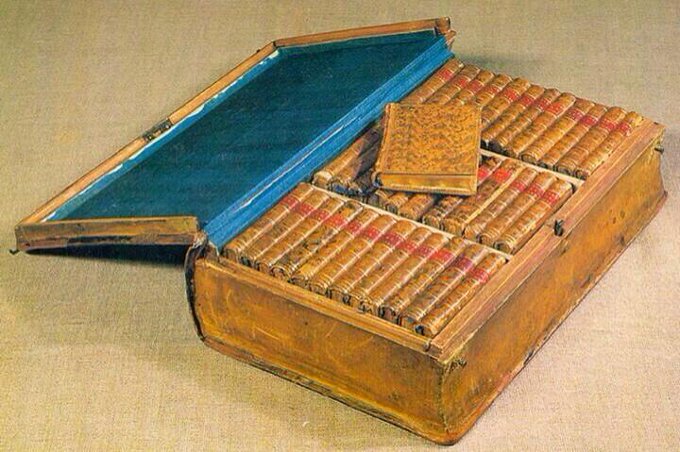
“Many of Napoleon’s biographers have mentioned that he […] used to carry about a certain number of favorite books wherever he went, whether traveling or camping,” says an 1885 Sacramento Daily Union article posted by Austin Kleon, “but it is not generally known that he made several plans for the construction of portable libraries which were to form part of his baggage.”
You’ve probably used an ebook reader or maybe even own one, but what would a Roman general have used to carry around his favourite poems by Virgil, Ovid, Horace, Lucretius, and Catullus when he was off on a military campaign? Miniature books stretch way back in history. While some miniature books are objects of high craft, bound in fine Moroccan leather, with gilt decoration and excellent woodcuts, etchings, and watermarks, others are cheap, disposable, and sometimes highly functional items not expected to survive. Thumb Bibles came out in the early seventeenth century. The first known thumb Bible, "An Agnus Dei”, was written by John Weever and appeared in London in 1601. It measured only 1.3 by 1.1 inches and contained 128 pages of six lines.
So it is not surprising that Napoleon who was an avid reader would carry around a miniature collection of his favourite books. Louis Barbier of the Louvre Library recalls that his father, who was a librarian to Napoleon, told him about the Emperor’s traveling library. Napoleon used to carry the books he required in several boxes holding about sixty volumes each. The books sat on shelves inside the boxes, which a well-known cabinetmaker supplied. The inside was lined with green leather or velvet, and the books were bound in leather. There was a catalog for each case, with a corresponding number on each book, so that the Emperor could easily find any book that he desired. As soon as he had selected his headquarters during a campaign, these cases were placed in the room which was intended to be his study, together with the portfolios containing his letters and maps.
Of course, it was not long before Napoleon found fault with his librarian when he couldn’t find a book he wanted in the collection. In 1803 he sent a message to Barbier to build a traveling library of one thousand volumes each measuring only 5 x 7.4 inches and holding 500-600 pages. Furthermore, he wanted forty works on religion, forty dramatic works, forty volumes of epic and sixty of poetry, one hundred novels, and sixty volumes of history, the remainder being historical memoirs of every period.
Napoleon must have been a very well-read man after some twelve years of military campaigns with long evenings waiting for the enemy to arrive and nothing much to do.
Comments ()